Learn more about the harsh realities of curing yourself before the FDA was established by exploring receipts & adverts from an early pharmacy in Fort Payne, Alabama. Some of the medications mentioned here directly tie into the creation of the FDA in 1906.
This research was presented at the Alabama Historical Association‘s Spring meeting in Fairhope (April 11th-12th).

A Quick Note:
My presentation at the Alabama Historical Association employed interactive cards (those held in the hand in the above image) that presented each audience member with a 20th century illness and their means of “curing” it using a medication found in this pharmacy. By the end of the presentation, each would know how they fared using a pre-FDA method. If you are interesting in using these cards, or something similar, as a teaching aid for discussing the creation of the FDA, please feel free to reach out to me.
When I recall lessons on the FDA from my early days of school, the focus was consistently on the food side of things. Perhaps because it seemed more attention-grabbing, especially for students, as it could draw upon squeamish and morbidly captivating facts pulled from sources like Upton Sinclair’s The Jungle. However, after recently digging into donated material from one of Fort Payne’s earliest pharmacies, I was struck by the oddity that the drug side was left out given how much it, too, contained those same hard-to-stomach elements of a train wreck you just can’t tear your gaze from.
The donation includes roughly 500 paper materials, largely pharmaceutical adverts and receipts from 1903-1904 – two years before the FDA was created. They come from one of the earliest pharmacies in Fort Payne, the Quin Drug Store, owned and operated by Dr. W.E. Quin. Given that the title of my presentation highlights the dishonest elements of this period preceding pharmaceutical regulations, I believe it is beneficial for us to spend a brief moment examining Dr. Quin (before diving into the hard-to-stomach drugs) so that you will understand that the dishonest portion of my talk is not ascribed to him (who has swiftly become one of my favorite figures from the archives).

William Everett Quin (or Quinn, depending on which archival source you’re viewing), was born in 1851 in Palo Alto, Mississippi. He received a bachelor’s degree in 1874 from Clinton College and his medical degree in 1881 from the Kentucky School of Medicine. He established a practice in Fort Payne in 1882 and also worked as a surgeon for the Southern Railway for 25 years. Outside of Fort Payne, he was a secretary for the DeKalb Medical Association for 25 years (serving one term as president), and was a member of the Alabama, the Southern, and the American medical associations.
In 1889 he founded his drug store, where the materials we’ll be viewing today came from, and I think it is perhaps here, in this store, where he secured his beloved position within the community. It was reported that Quin never turned away a sick or suffering individual from his services, even if they could not afford to pay him. While I think this generous medical care would be enough to endear the town to him, it wasn’t all he did for them. When the city’s boom era disastrously collapsed in 1892, he was one of the three men who formed an industrial committee to seek out a new industry that could save the failing city (said industry being hosiery, for which the city of Fort Payne would later become known). He then served as mayor and continued to prove a charitable force in the young city. When he passed away in 1937, it was concluded that his three outstanding characteristics were honesty, truthfulness, and charity. And, if you visit his graveside today in Glenwood Cemetery, you’ll find that it reads simply “here lies an honest man.”
Suffice to say, it is not my view that Dr. Quin knowingly sold fraudulent or ineffective drugs to his patients, particularly given that he would often offer medical aid without any monetary incentive on his part. Rather I feel that he, like so many others of this time, fell victim to the promises sold by these unchecked drug companies of his era – a time marked by widespread incurable disease, like tuberculosis, that left many desperate to try whatever they could to cure themselves (a sentiment that we, recovering from our own pandemic, may well be familiar with).
To paint a picture for you, this time period seems, to me, to be a bit of a “Wild West” of drugs. There’s no regulatory body whatsoever, and even when we do get the FDA in 1906 it is nowhere near close to providing the securities we enjoy, and oft take for granted, today (to provide a bit of context on that journey, please review the general, and not comprehensive, timeline below).

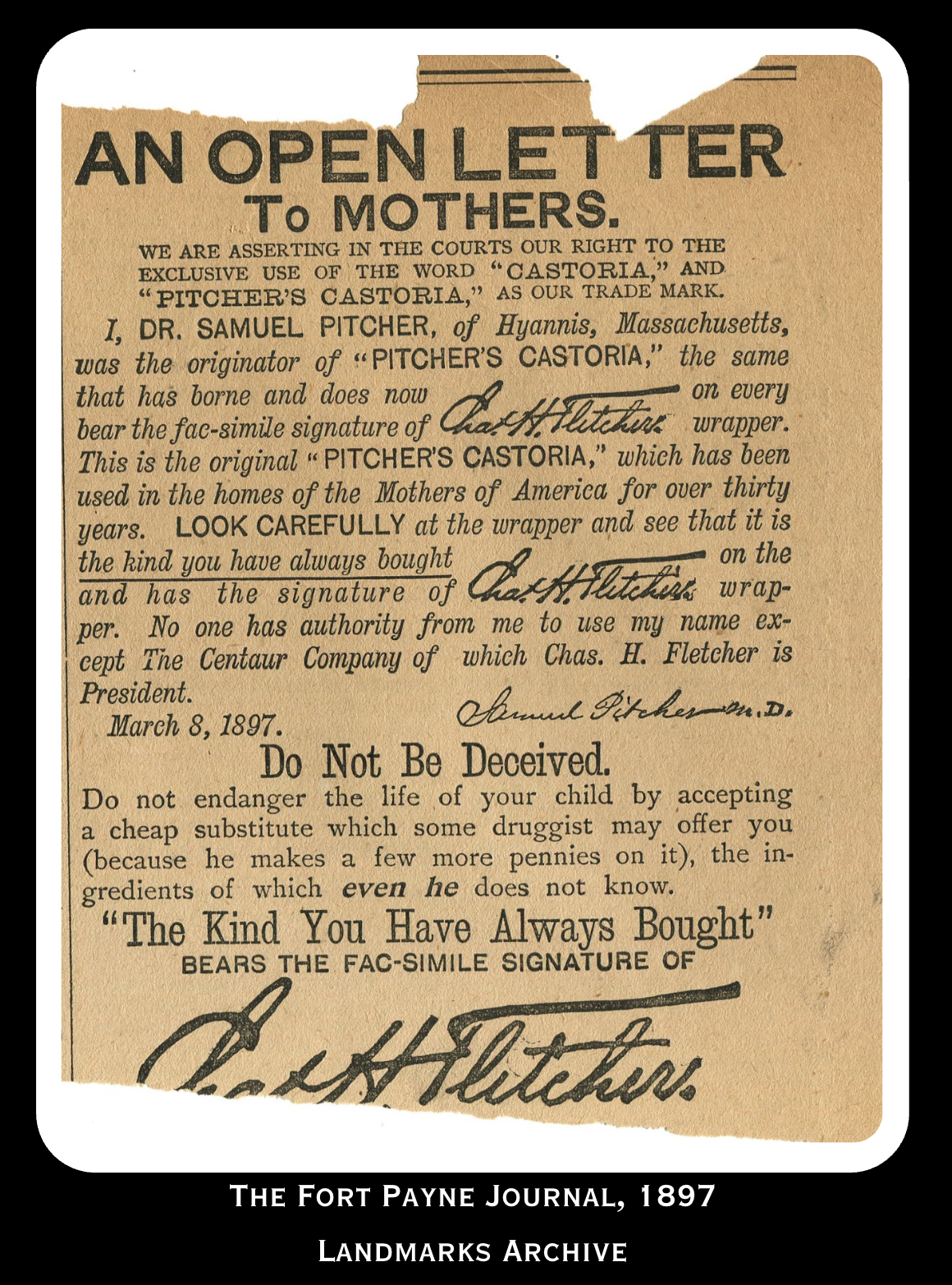
At the time of these receipts (1903-1904), the individuals who were creating and marketing these drugs to doctors and the public alike would do so without providing an ingredient list to consumers or practitioners. This was done, as was claimed, in fear that their formula would be stolen (or, as I think, that their snake-oil would be clearly spied by doctors). There is yet no governing authority requiring that these businessmen disclose this information, nor prove the safety or efficacy of their drugs. There were also, as we’ll soon see, no checks on their marketing campaigns. These advertisements, sent to pharmacies, doctors, and directly to newspapers, were allowed to make any and all wild manner of claims for their drugs (curing everything from pimples to cancer with just one drug!) and there was no one (save a few who’d later advocate for the FDA by decrying these drugs) who would, or could, check them. Given that these wild advertising campaigns make up such a large part of this “Wild West,” I thought it would be fun for us to introduce each drug that we’ll be discussing today (each ordered in one or more of Dr. Quin’s receipts) by employing one of the many advertisements I found for each drug.

ADVERT: “Merrill of Massachusetts says of Dr. King’s New Discovery that he has used it and at every opportunity recommended it to his friends and never saw it fail to give relief. He says he would not be without it for anything and had rather have it than a doctor. He takes great pleasure in saying a good word for so valuable a remedy because Dr. King’s New Discovery is safe, pure, unequaled for coughs and colds, and above all it cures.”

So what exactly is this wonderful drug? Dr. King’s New Discovery comes from the H.E. Bucklen company, who were widely successful at selling fraudulent drugs. To maximize profits, they claimed that each one of their drugs could cure all manner of ailments, especially if those ailments were otherwise incurable, like the claim this one made of curing tuberculosis (which wouldn’t actually be cured until the 1950s).
Now, if you have the card for this (seen in image to right), you’ll know that using this to treat TB won’t cure you, but instead it will actually kill you faster (so if you drew this card I’m afraid you won’t be able to visit the pharmacy again…).

Rather than treating TB, this drug instead halted your body’s natural immune response. It was a chloroform and morphine (or opium) mixture that allayed your cough and, due to the opium, would give the patient a false cheerfulness (so, to yourself and to others, it would seem that you were on the mend). But, without your immune response, the disease can work faster, and it will make your typical prolonged death from consumption far more swift.

Many of the drugs we’ll be discussing caused enough public outcry to lead to the creation of the FDA, and this company (H.E. Bucklen) in particular drew the ire of Dr. Samuel Hopkins, who was a prominent advocate for the government oversight of pharmaceutical drugs. In 1906 he wrote a series of articles in Colliers Weekly demanding that the government protect citizens from these fraudulent drugs, and in one article he specifically calls out the Bucklen Company as helping “no one but the undertakers” with their cure for tuberculosis. And it’s not the last we’ll find of this company in Dr. Quin’s pharmacy.

ADVERT: “The piggywig had roast beef – just think! And he laughed in his high backed chair. And slice after slice went down in a trice for he found it so juicy and rare. And he called to his butler, so stately and grand, “some electric bitters is now just the thing, to preserve me in health, which is better than wealth.”

So what were electric bitters? It was presented as “the great family remedy for all diseases of the stomach, liver, kidneys, biliousness, general debility, fever and augue, jaundice, blood disorders, diseases of urinary organs, neuralgia, nervousness, and mental depression.” It was banking off the popularity of electricity. [As a bit of background, there were a lot of quack medicines that used the new fad of electricity to market their drugs (most of which had nothing at all to do with electricity)]. Now, there were products at this time, like an electrified ginger ale, that used an electrically generated ozone-gas in their water treatment source, but that’s not the case with our drug of choice today. Like other misleading products from this company, there was nothing electric about this cure. Rather than zap you into health, it’s more aptly going to zap you into the nearest outhouse. This was a laxative, as a lot of these older medications were (bodily purging was still a very popular treatment), so if you’re using this for constipation after a heavy meal it will certainly help, but if you’re trying to use this for any of the more serious ailments that this drug claimed it could cure I’m afraid it may leave you a little worse for wear…. (In which case, perhaps you should try our next drug from this company).

ADVERT: “The greatest medical wonder of the world! Warranted to speedily cure burns, bruises, cuts, ulcers, salt rheumatism, fever sores, cancers, piles, chilblains, coins, tetter, chapped hands, and all skin eruptions. Guaranteed to cure in every instance, or money refunded.”

Dr. Bucklen’s Arnica Salve is a drug that was, like many, knowingly fraudulent. When Bucklen (who was not actually a doctor) was later asked if he had any of his acclaimed palliative on hand, he simply replied “go take some axle grease off your wagon wheel, it’s the same thing.” Of course, that later admission comes after the mass popularity of this product from its unchecked advertising campaigns.
Now, that’s the last we have from the H.E. Bucklen company, but don’t worry, we still have plenty more drugs in store.

ADVERT: “Liquozone is not made by compounding drugs, nor is there alcohol in it. Its virtues are derived solely from gas – oxygen gas – by a process requiring immense apparatus and a 14 days’ time. The result is a liquid that does what oxygen does. It is a nerve food and a blood food – the most helpful thing in the world to you. Its effects are exhilarating, vitalizing, purifying, yet it is a germicide so certain that we publish on every bottle an offer of $1,000 for a disease germ it cannot kill. The reason is that germs are vegetables, and liquozone, like an excess of oxygen, is deadly to vegetable matter.”

This cure-all claimed to be liquid oxygen but, as our friend Dr. Hopkins would note in his retort against it: “it was a very good thing that this was a fraud, otherwise just one teaspoon would freeze a man’s throat so solidly that, if he did manage to get it down, the undertaker would need to thaw him out in a furnace in order to give him a decent burial.” This product was, by all reports, actually nothing more than water. So, you’re essentially using water to cure more serious diseases like consumption. With no checks in place to stop them, this manufacturer had a huge marketing campaign and, it turns out, had paid for a good deal of phony endorsements to lend credibility to their cure-all claims.

ADVERT: “Mother, you know the summer will be a trying time for your teething baby – a period of anxiety and sleepless nights for you unless you take the precaution to keep baby’s system in condition to make teething easy.”

Teethina was a teething powder that promised to allay irritation, aid digestion, strengthen the child and make them as “fat as a pig.” In actuality, the child would lose weight. Their hands and feet would become icy and swollen and their flesh would begin splitting off. They would scream and cry and tear at their own skin. This was known, in 1921, as Pink’s Disease, but by 1950 we would recognize it for what it was: mercury poisoning. Teethina contained calomel, which is a more unfamiliar name for mercury. With this drug parents of the era, who were simply trying to relieve their child’s pain, were instead treating them to mercury poisoning. At a time when the horrors of mercury poisoning were not yet known to medical professionals, this seems it to have been an unpreventable learning curve, but keep in mind that, with the trials and testing we have in place today in order for drugs to gain approval, unknown hazards like this are not a threat we’re likely to face (and perhaps products like Teethina would not have made it to the prescription stage in the past if there had been such oversight). If I had more time, I would tell you about another hazardous children’s drug (Mrs. Winslow’s Cough Syrup), as this wasn’t the first time children suffered horrible fates from unregulated drugs, but instead I’ll have to move on to our last drug of the day.

ADVERT: “Athletes and pugilists cured by swamp-root! James J. Jeffries, boxing champion, says he uses it in his training to strengthen his kidneys and it does the trick every time. He says it’s a wonderful remedy and he wouldn’t be without it.”

Swamp Root is one of these fraudulent products that also went on a massive advertising campaign (perhaps the largest), as you saw from that brief ad from 1904. They had many nationwide advertising campaigns and if I were to list everything they claimed Swamp Root cured, I’d very quickly be over my time limit. But know that, in addition to keeping your kidneys in good health, it promised to offer a range of other benefits, from fixing your pimples to curing your consumption.
I think this drug really takes the cake for highlighting the problems of this “Wild West” era preceding the FDA, and that’s why I wanted to end here in particular. This company thrived on mass, dishonest, and unregulated marketing, constantly making wild claims with no studies to back them up. It was made by a man named Dr. Kilmer (a homeopathic physician). It was composed of herbs, oils, and 24% grain alcohol. Essentially, it is an alcoholic herbal remedy that, as the manufacturers claimed, could cure everything, even incurable diseases like tuberculosis. When Dr. Kilmer’s brother and nephew took over the company, it began its famed mass marketing campaign which, from my perspective, appears to have been to be little more than a cash grab. To give you an idea of what I mean, when his nephew was once asked what exactly Swamp Root is good for, he replied “about a million dollars a year!”
It is telling that, once we have an FDA that is able to better regulate these sorts of fraudulent drugs, Swamp Root was pretty swiftly out the door, despite its mass popularity obtained from its nation-wide advertising campaigns. With the FDA, our other drugs would soon leave shelves, too, though not as quickly as you might think (we might take for granted the many protections we have in places today, but it took decades to strengthen the FDA to secure these protections).

With that, we’ve just wrapped our trip through time to the pharmacy, and I hope you were all dealt a good (enough) hand to have survived your 20th century illness (though I know we, inevitably, lost some of you along the way).
At first glance, I know these drugs and their advertisements all seem so archaic and distanced from us now, as though we have progressed so much at present that we could never again be fooled by such things, but as I was doing this research I couldn’t help but draw similarities to our present. The recent opioid epidemic saw its rise in the lessening of FDA protections governing pharmaceutical advertisements. More recently, after the pandemic, (though it had roots growing well before it), we’ve seen a rise in distrust over regulated medicines, like vaccines, which have been secured for us through the rigorous safety measures obtained over decades of progress (and by the very lives lost in the years before those measures were in place). Continuing this distrust, I know that I, personally, have seen countless influencers peddling wellness treatments on social media that (largely) are not approved by the FDA and for which they cannot prove their efficacy, often at the cost of human lives, as seen in recent documentaries on alternative treatments for cancer. The rise in influencers peddling wellness trends all feels to me that Dr. Keister, in his 1894 article quoted below, could have just as well been writing to our public today, if one replaces newspaper with smartphone and editor with influencer).
“How preposterous the idea seems for an intelligent being to take into his stomach a mass of things that he knows nothing under heaven about, except through the flattering, false description that he reads in a newspaper, whose editor knows no more about it than he does about the function of the vermiform appendix….”
-“Some Things That Should Not Be Forgotten By the General Practitioner,” Dr. B.C. Keister. Published in the Journal of American Medicine, c. 1894.
It’s far too easy for us to become complacent with our progress and forget just what it took to earn these very securities we now enjoy (though these securities are, as with most aspects of our ongoing American experiment, still a work in progress). I think that we here, as historians, all know that this risk of complacency runs especially true when we fail to teach these aspects of our history (and that this complacency means we will see these forgotten chapters of our history play out again).
Though hardly remembered now, it is thanks to these hardwon efforts, to these long decades of progress toward regulation and protection, that we today fare far better than our predecessors did when an ailment strikes us (so much so that we can now take for granted just how much benefit has been won for us and, for some among us, can desire to pull apart a department decades in the making). In times of hardship and uncertainty, it’s easy to fall prey to those desires, but I think it is important, when such discussions come about in the public or political sphere, to discern what the person advocating for such dismantling stands to gain from it (at times I find that this comes not from any desire to protect consumers, but rather as a way for those behind these measures, perhaps trying to sell their own currently unregulated medicines, to better get their foot in the door and your money in their wallet – our snake-oil past has never really left us, but we come by it [dis]honestly). In these times, I believe it is important for us to look back at our past while remembering the gains of our present.
Today, unlike our predecessors, we and our doctors can know the ingredients used in a drug before we ingest it. We can be assured that a federally approved drug has been tested in trials before it reaches us, so that we are aware of what risks exist (and if those are risks we are willing to take). Though we are still advertised to (and have even seen the risk that comes with backsliding in this area in the recent opioid epidemic), there are protections in place that prevent false advertisements that those before us fell prey to – for the most past, we know what efficacy exists in whatever drug we’re taking and its side effects. We don’t have a perfect system – by any means, and there is always more work to be done – but I think there is a great deal to appreciate in the securities we have at present (if I may quote a phrase from home, we should take care not to throw baby out with the bathwater). If we want to have adequate progress, we can only do so by learning where we’ve been (and, if I may be so biased, a good way to start is by paying a trip to an early 20th century pharmacy in a small Alabama town).

This research could not have been possible without the generous donation of Glen Horton, who donated boxes of pharmaceutical materials that were found inside the Quin Building to Landmarks of DeKalb County in 2022. I also want to thank the Society of Alabama Archivists who selected me to attend their inaugural research and writing retreat hosted at Auburn University, where much of this research was composed (and a big thanks to that university for the lovely week spent at their historic Pebble Hill – and my apologies to my staunchly Alabama-football family for that trip!). I’d also like to thank Landmarks for their commitment to preservation and for their continued support of my work.

The above is a reproduction of my research as it was presented at the AHA. Due to time constraints, much of my original project was cut. The remainder of this project will soon be featured in a separate Archival Scoop (this will include more drugs that had to be cut for time as well as court cases and articles regarding these drugs, which would lead to the formation of the FDA, and more connections from this period to our present moment).
I am also continuing this work (in a Part II) through an analysis of local DeKalb County newspapers around this time period. I am searching these papers for any mention of suspicious deaths that may have been linked to these drugs or for any further mention of the drugs. If you happen to have a local paper that mentions any of these drugs (or other interesting medical tidbits of the time), please feel free to share those with me.