Explore the history of hosiery in the former “Sock Capital of the World”
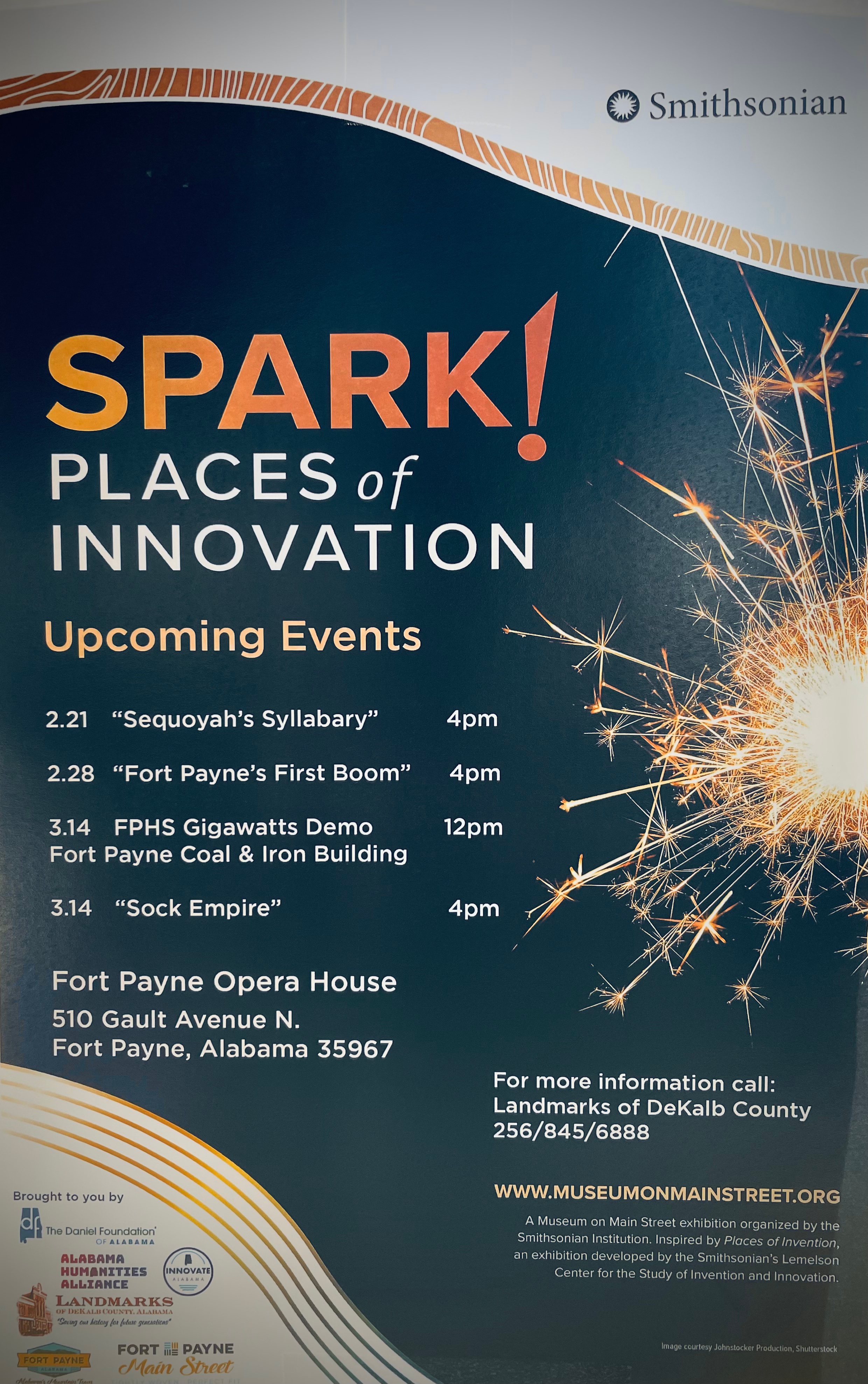
This research was presented on March 14th in conjunction with the Smithsonian’s traveling exhibit (Spark! Places of Innovation) that was hosted by Landmarks of DeKalb County from February 21st until March 25th. It follows the history of hosiery in Fort Payne as detailed in the new renovations I’ve installed at the Hosiery Museum.

As I narrate the story of hosiery during tours at the museum, I always begin with a simple question. How many of you are familiar with the Great Depression? Unless I’m speaking to very small children (who even then surprise me with just how much they know of history), the answer to this is usually a resounding “yes, of course. I know all about that.” My follow up question, however, tends to ring zero bells for our guests: “What about the Great Panic of 1893?”
I like to begin with the Great Panic as it helps to set the stage for the dire straits Fort Payne was in at the time the spark of our hosiery empire was lit. The Great Panic of 1893 lasted for 8 long months and was the most severe economic depression our country had faced before the Great Depression of the 1930s (which has, I imagine, long overshadowed the 1890’s depression). The boiling kettle that was the Gilded Age had at last grown too full of its own fumes and burst. Unemployment rose, toppling over 25% nationwide, and, though the Gilded Age had always hid its disparities beneath its shiny veneer, poverty was now far too widespread to polish over.
In Fort Payne, however, it was reported that this nationwide panic was not felt with the same shock that had gripped the rest of the nation. That is only because Fort Payne, a mining city that had been incorporated by investors from New England, had felt its own economic bust the year prior. The booming city, in which the Fort Payne Coal & Iron Company had an advertised capital of $5,000,000, was not producing the quality coal and iron ore that the investors had expected. All the high hopes they had held for this “New England City of the South” were long gone by 1892. The new businesses, in their fine brick buildings, suddenly closed up shop. The lovely Victorian-style houses were (largely) abandoned. And the new electric lights of the booming city all went dark.
Not everyone in Fort Payne had invested in the boom, of course, but that had made little difference to their wealth by the end of that era. The valley that had become Fort Payne had held around 400 people before the boom in 1889 (the name “Fort Payne” comes from the military fort constructed here during the Trail of Tears when this area was still Willstown, a part of the Cherokee Nation). But these early residents of the former trading town were largely poor (subsiding on agriculture) so they had nothing to invest when the families from New England arrived to build a city. But for those residents who had been wealthy enough to invest, (such as Quin and Sawyer, who I’ll mention again in just a moment), they had lost significant wealth. Most, but not all, of the investors had fled the city (the archives at Landmarks contain a Philadelphia newspaper that details the fates of some of these men, which were far from pleasant). But not everyone who had invested in the once-booming city abandoned Fort Payne or its people (the residents, both new and old, now somewhat leveled in poverty).
Among those who remained were three future mayors of the young city: Dr. W.E. Quin, Charles M.T. Sawyer, and Henry B. Brock. Together these men formed an industrial committee that set out to find a new industry to take root in Fort Payne and save it from becoming a ghost town (as was often the fate of failed mining ventures). This one decision was the first domino to fall in reshaping Fort Payne’s fate.
In 1906 the committee sought out three hosiery magnates from Chattanooga, Tennessee, (W.B. Davis, James H. Witherspoon, and Karl Shippmann). A meeting was held in the DeKalb Hotel (a grand 125-room hotel that used to stand overlooking City Park in the lot where Hammer’s and other department stores now sit). At the meeting the men from Chattanooga agreed to turn one of the abandoned buildings from the boom (a former hardware store) into a hosiery mill. By 1907 the Florence Knitting Mill had, with the chime of a steam whistle, officially opened its doors and Fort Payne was then on the road to becoming the “Sock Capital of the World.”
At first the mill employed only women and children, but as it expanded (and more rights were secured for workers) the business would shift to hiring men as well as women (leaving out child labor entirely, much to the unexpected disappointment of a few school children I taught at the museum). As the change in hiring practices was ongoing, we also find a change in management. In 1915 W.B. Davis along with his son, Robert Evans Davis, and our old friend Charles Sawyer (from the industrial committee) buy out W.B.’s partners. With this shift in management comes a new name for the mill, one that many in Fort Payne will recognize today: the W.B. Davis & Son Mill (which, at present, houses Vintage 1889, a small restaurant that I highly recommend if you’d like to peek inside the old mill while enjoying good food).
Under the Davis family the mill truly begins to reshape the city. While the water treatment plant, built by the Coal & Iron Co., was the one amenity of the boom era that didn’t collapse, it was improved by Davis after he purchased it in 1916. To give a sense of the impact of these improvements, there is a report in the archives that mentions how those who worked in the mill didn’t have to pay for water and so, once the city later took control of the plant, there was a brief upset as individuals now had to pay for their water. In addition to improving the water treatment plant, Davis also brought back electricity by building his own electric system for the mill.
In addition to these improvements, there were several firsts for Fort Payne that were brought by the Davis Mill. While there was perhaps an incentive to treat one’s employees well given the rise in unions and labor stoppages at this time, Davis was reported to be a man committed to the welfare of his employees. He built a recreation room, installed a full-time nurse (very useful for a city that had only two doctors), built a church (which would later become the Second Baptist Church that still stands today), and constructed a clubhouse that held the first radio ever installed in Fort Payne. He also built the first swimming pool in 1922 (later filled in and no longer here today) and his son even provided the first fire department (there’s a fascinating photo now on display in the museum that shows these first firemen surrounding a firetruck proudly labelled “Dad Davis’ Fire Fighters”).
While wages at the early mill were much higher than in neighboring states, the business was nowhere near receiving the national recognition it was destined to have. That would come with R.E. Davis, who took over the mill from his father after W.B.’s death in 1934. There was a day in 1936, as we begin to approach the second world war, where R.E. was playing with his children and received terrible blisters on his feet. A spark was lit, and he designed a wool-lined, absorbent sock, the 4-D Cushion Foot Sox, that would later catch the attention of the US Army. During WWII, Davis waved the rights to royalties for his patented socks in order to help the US afford more production of these socks, and so during the course of the war in the Pacific over 50 million pairs of 4-D Cushion Foot Sox were produced and shipped overseas. This wartime effort earned the Davis Mill the Army Navy “E” Award for Excellence and a ceremony was held at the mill where Major John Gibbons proudly proclaimed that this sock “has brought great comfort and joy to thousands of our soldiers.” Fort Payne was now known in the world of hosiery, but it was not yet the world’s leading producer of socks.
The rise to worldwide fame would come after the Davis Mill. While our city’s first mill did move back into a civilian line of production after the war, Evangeline Davis (the wife of R.E. who was a behind-the-scenes force at the mill, designing patterns that would later be produced by her son at his own mill), had passed away in 1948 and, just nine months after her death, R.E. sold the mill in Fort Payne and retired from the industry. His sons would start other mills of their own in DeKalb County (producing various innovative items from socks, like the Therma-Jacs coasters, golf clubs, and more that are all available to see in the museum), but by that point hosiery in Fort Payne had stretched beyond the Davis mills (although every new venture did tie back to that first mill in some way).
You would be hard-pressed to find a mill in Fort Payne that was not founded by someone with ties to the Davis Mill. At the height of our hosiery industry this area boasted well over a hundred mills and most all could trace their roots back to W.B. Davis.
Henry Cobble (whose surname might be familiar to you as his brothers founded a “tufting legacy” in Chattanooga), left Tennessee in 1924 after being recruited by W.B. Davis. He remained at the Davis Mill until the Great Depression when he, at a time when most were out of work, started a new mill alongside CJ Smalley and the Gilbreath brothers (W.D. Jack, Houston, and Noah). This first mill was known as the Fort Payne Hosiery Mill and, while work started small, the mill began to find more success as the effects of the Depression began to lift. In 1938 it had expanded into the DeKalb Hosiery Mills. By 1954 Cobble’s success with hosiery was such that he was able to buy out his partners, turning the mill into the sole Cobble family business that most remember it for today. Cobble, like others in our local industry, continued Davis’s legacy of giving back to the community. He financed a number of charities and worthy causes in the city, including the construction of the original stadium at Fort Payne’s athletic field and the construction of an educational building for the First United Methodist Church (still named for him today).
W.Y. Shugart of W.Y. Shugart & Sons founded his mill in 1937. He, too, received his start at the Davis Mill, working from 1918 until 1936. His mill, like many in Fort Payne, was a family business and would stretch its way into nearly four generations before the eventual collapse of the industry. While most mills expanded into broad production that was easier to mass produce, like tube socks, the Shugart Mill focused more on labor-intensive and very detailed work, designing intricate adornments for children’s socks. While the mill grew to be very successful from this work, it was reported that it never lost its “mom and pop” quality, something that seems to have held true for most of the mills in this city.
Ida Goza, ever a woman of firsts, was the first woman in Fort Payne to own and operate her own hosiery mill. She also received her start at the Davis Mill in 1925 at the age of 17, taking the escape from rural outdoor work that the mill offered. At the age of 47 she showed that it’s never too late to challenge yourself by opening her own hosiery mill, Bonnie Mills. She would go on to open others, including Spring Hosiery and Eagle Mills, and would even be successful enough to purchase the Davis Mill where she had received her start. While paving the way for women-owned businesses in the city, she also became the first woman to run for the office of mayor and the first woman in Fort Payne to own an airplane (if you didn’t know, there is a small airfield in the city). Despite her enormous success, she is perhaps remembered most fondly for her charitable nature, recalled as being one of our most benevolent citizens.
Leman Cooper, of the still-surviving Cooper Mills, started at the Davis Mill in 1930 at the age of 15. He began as a transfer knitter, standing on an apple crate to reach the machines, but he had a knack for mechanics that caught the attention of W.B. Davis. Davis sent him to Rhode Island to study at the Banner Factory in Pawtucket and Cooper returned able to resolve any technical issues that arose (a skill he would retain even as the machinery advanced beyond those of the 1930s). While he worked at the Davis Mill, he was known to assist other mills with technical issues and, when he opened his own mill with his son, Mack, in 1961, he was still reported to be just as generous with his skills. One article from the archives recalls how he was known to freely share any new improvements he’d discovered with the surrounding mills (a charitable trait you’d be hard-pressed to find among most business owners today). This generosity with his innovations doesn’t seem to have hampered the success of the mill, though, as his mill remains one of the few that survived the industrial collapse of the early 2000s.
While every mill in the city played a part in Fort Payne’s rise (many more than can be mentioned here), perhaps the players with the biggest push towards our worldwide acclaim would come from the Prewetts. V.I. Prewett, Sr., like the other founders we’ve discussed, received his start at the Davis Mill, where he worked from 1920 until 1944. In 1945 he went on to work as a superintendent at the W.Y. Shugart Mill, but soon enough he would go the route of the other founders by starting his own family mill. In 1953 (following his son’s suggestion), he went into business with said son, V.I. Prewett, Jr., and their wives (his wife, Alice Prewett, and his son’s wife, Lala Prewett). His family’s mill, named V.I. Prewett & Son, had humble origins, as most of our local mills did. It was a small operation that was run out of their garage using only 12 Standard H. Knitting Machines, 6 Brinton Ribbers, and 3 Sotco Looping Machines (all purchased secondhand). They used a homemade top-pulling table (manned by Lala Prewett) and, at the end of the production line, every sock was inspected by Alice Prewett from the family’s kitchen table.
At the start they had only 6 full-time employees and 8 extras and it was, by all accounts, a difficult venture. Some reports from the archives (taken from preserved copies of the internal employee-run newsletter their mill would later produce), remark that V.I., Jr., had to, at times, borrow money in order to meet employee payroll and Lala would, meanwhile, pray for a check to come in so that they could afford to buy their groceries. Looking at this mill at its offset, one would never imagine that it would expand into a powerhouse that could launch Fort Payne into its title as the world’s sock capital. Though it seems that the Prewetts themselves had never envisioned the enormity of their coming success, either, as Lala had remarked during their mill’s 50th celebration (in a short speech that is available to read in full at the museum).
When business for the Prewetts took off, it took off for Fort Payne as a whole. Their humble little mill would become so successful that it would expand beyond the scope of their garage, eventually moving into the familiar building on Gault Avenue that, while empty now, still bears the family’s name. It would also expand beyond their own mill. The Prewetts were known to help finance employees to help them start mills of their own, and soon there was an entire family tree of mills that all tied back to VIP. By 1996, this little venture that had started out of a garage was the largest producer of socks in the United States.

As you might have guessed the Prewetts, like the other hosiery founders we’ve discussed, did not let success prevent them from remaining focused on their community (and their employees). The archives at Landmarks are filled with copies of the VIP News (the internal employee-run newsletter) which boast many fond memories of the mill’s four founding members:
“He [V.I. Prewett, Sr.] cared about people, great or small. To him there was no difference between a customer and a supplier, a rich man and a poor man, an executive and a worker, a leader or a follower.”
“She [Lala] treated everyone as if you were part of the family and made you feel as if your problems and opinions really mattered.”
“V.I. [Jr.] was a one of a kind person. He was so friendly that he never met a stranger. After you talked with him for five minutes for the first time you felt like you had known him all your life.”
“You don’t find people who care about their employees the way they [the Prewetts] do.”
There was also a number of fun events that took place for employees while working at the mill, from holiday parties to a private concert by the band ALABAMA (to see the full range of events, be sure to pay a visit to the Hosiery Museum), but chief among these activities for those at the Prewett Mills (and the other mills in Fort Payne) had to be National Celebrate Hosiery Week. By official proclamation made at the height of the hosiery industry (around the very late 1900s), one week in August was reserved to celebrate this booming industry. In Fort Payne all the mills took part, shutting down operations to host various fair-like festivities. There were cookouts, tournaments (sports, fishing, horseshoes, etc.), and even blow-up houses and slides (much like you’d find at a county fair). It was a huge event for Fort Payne and showed just how integral hosiery had become for the city. Scholarships were hosted through the mills to send students to school, jobs were secure and plentiful, and various charities were funded and supported by the industry. It was beyond the bread and butter of Fort Payne. It was an entire identity. But, as it goes with all things booming, there must always come a bust.
As we begin to approach the turn of the century (venturing into the 2000s), the nature of the business slowly begins to change. We’re now entering into a global market with increased competition where cotton prices are soaring and there’s growing concern that Congress may pass bills that make it easier for US-based companies to do their production outside of the United States. In a 1995 congressional record featuring Jesse Helms, a Senator from North Carolina (also a leading producer of hosiery), we can begin to discern the growing fears surrounding this industry:
“Mr. President, while driving to the Capitol this morning I fell to thinking about what a calamity it would be if, all of a sudden, the hosiery manufacturing business in America were to shut down. How many jobs would be lost? How would the economy be affected? How would our country’s trade balance with other countries be affected? And how many grandchildren would have to think about something else to put under the tree for Grandpa next Christmas? None of the above is an idle question, Mr. President, and I bring up the subject because next week will mark the 24th observance of National Hosiery Week. So beginning on Monday, August 7th, will be a time to pay our respects to a great American example of free trade, the hosiery manufacturers of our Nation.”
Despite these concerns, the tide continued to turn against hosiery. In 2005 the Central American Free Trade Agreement (CAFTA) was passed, which many here in Fort Payne still point to as the final nail in the coffin for our local industry. This bill made it easier for US corporations to produce their goods outside of the US (where workers don’t have the same protections ours enjoy that secure, at the very least, a minimum wage). The Representative for DeKalb County, Robert Aderholt, became the final vote needed to pass this bill. Though initially against CAFTA, Aderholt shifted his stance once the Bush administration rejected his safe-guarding provisions for the bill. Amidst fallout from his constituents, Aderholt stated that he had secured pledges from his fellow Republicans in Congress to help safeguard the Alabama industry once CAFTA was passed, but, as it tends to go with these things, such pledges were never fulfilled.
Two years after CAFTA passes (and three after Lala, the last surviving founder of the Prewett Mills, passes away), the Prewett Mills are sold to a Canadian company, Gildan-Activewear, and the unsteady nature of this foundational industry becomes clear to more and more residents in Fort Payne. Gildan maintains the local mills until 2011, when they admit defeat (local production cannot compete with overseas production), and close down a pillar of local industry. With the collapse of the Prewett Mills, the other mills begin to fall like dominos until only a handful remain.
History, in its bitterly ironic fashion, is so often cyclical and that nature proved true in Fort Payne. The former boom city, built to compete with Birmingham in coal & iron production, had been saved from its ruinous bust by the hosiery industry, reaching far greater heights than its first boom ever could have imagined. But this boom, too, collapsed and left Fort Payne, once more, economically devastated. Mills closed, unemployment drastically increased, and the city was left in much the same boat as it had been all those years ago when hosiery had first lit our spark of innovation.
But, like before, people remained who were committed to their community. Not every mill closed, (some, like Cooper’s, managed to weather the economic hardship and still remain in operation today), and, surprisingly, new industry opened. In 2007 Gina Locklear, who had grown up around her parents’ mill, Emi-G Knitting, saw the collapse of the industry that had stitched her town together and wanted to do something about it. She began a line of 100% organic cotton socks, locally sourced and produced in her parents’ mill. This first line, Zkano, garnered national attention in only a short span of time with notable influences like Martha Stewart, the New York Times, and more all praising her socks. In 2013 Zkano’s success allowed her to start a second line of socks, Little River Socks, which continues today alongside Zkano. So, though no longer booming, this industry is far from gone in the world’s former sock capital.
Though the story of socks may at first seem like nothing more than a city with an odd claim to fame (former “Sock Capital of the World” may seem a touch quirky from an outside glance, after all), when you dig into the history here you find that the story of socks is really much more than that. Just as we have seen throughout this traveling exhibit from the Smithsonian, this is a story of people for whom a spark had been lit. A spark of innovation, a spark of care, a spark of drive and determination. From the industrial committee of the collapsing boom-era, who sought out a new industry that would take root far beyond anything they could have envisioned, to the later mills with such humble beginnings that none would ever have bet on their success, the connective threads of this story remain the same. Looping threads of people who followed a spark, despite not knowing where it would lead, and that has made all the difference.
“[Fort Payne] is a town with a lot of potential. It’s got a lot of good people in it. With the right motivation, it could really take off.”
-Rhonda Whitmire, employee of Zkano, c.2017